
In an era shaped by climate challenges and global interdependence, education is increasingly expected to foster not only academic competence but also values, awareness and responsibility. Language education, in particular, offers a powerful opportunity to introduce sustainability concepts at an early age. The Eco Lingua approach reflects this vision by integrating environmental education into language learning, supporting young learners in developing linguistic skills alongside ecological awareness. As highlighted in eco-linguistic initiatives focused on early childhood and primary education, language classrooms can become meaningful spaces for nurturing environmental responsibility and global citizenship.
The Role of Language Education in Building Eco-Consciousness
Young children are naturally curious about the world around them. When environmental themes are embedded within language lessons, learning becomes both relevant and engaging. Vocabulary related to nature, animals, weather, food, recycling and habitats gains deeper meaning when connected to real-life ecological contexts.
Eco-linguistic education uses stories, songs, games and interactive activities to connect language learning with environmental understanding. For example, learning a second language through stories about forests, oceans or wildlife protection encourages children to associate communication with care for the planet. This integrated approach supports cognitive and emotional development while fostering values such as respect, responsibility and cooperation.
Eco-Linguistic Practices in Early Years Education
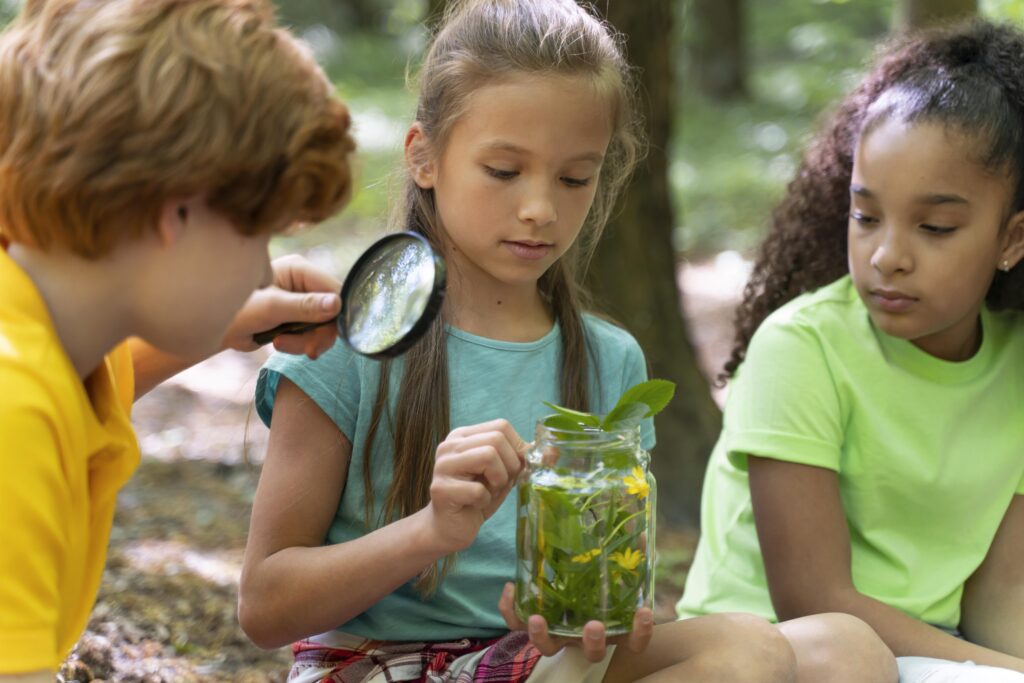
Effective eco-linguistic teaching prioritises experiential and project-based learning. Activities such as planting seeds, sorting waste, observing local wildlife or creating eco-themed artwork enable children to use the target language in authentic and meaningful situations. These experiences help make abstract sustainability concepts accessible and age-appropriate.
Teachers act as facilitators, guiding discussions, modelling environmentally responsible behaviour and encouraging reflection. Everyday classroom practices—such as talking about saving water, reducing waste or caring for classroom plants—reinforce sustainability as part of daily life rather than as a standalone topic.
Assessment within eco-linguistic education also takes a holistic approach. Instead of relying solely on traditional language tests, educators observe children’s participation, creativity, communication and engagement with environmental ideas. Projects, group work and reflective activities provide valuable insights into how learners integrate language skills with ecological understanding.
Long-Term Benefits: Educating Responsible Global Citizens
By nurturing eco-consciousness through language education, children begin to recognise their role within a wider global community. They learn that language can be used to express care for the environment, share ideas and contribute to positive change. Early exposure to sustainability concepts helps establish attitudes and behaviours that can last a lifetime.
The Eco Lingua approach demonstrates that language learning goes beyond linguistic accuracy or fluency. It supports the development of thoughtful, informed and socially responsible individuals who are equipped to engage with global environmental challenges.
Integrating environmental education into language learning offers a powerful and meaningful way to nurture eco-consciousness in young learners. Through stories, projects and reflective practices, children develop language skills while building awareness of sustainability and responsibility. As eco-linguistic approaches continue to grow, they offer significant potential to inspire a generation that communicates with purpose and acts with care for the world around them.
REFERENCES:
Coyle, D., Hood, P., & Marsh, D. (2010). CLIL: Content and Language Integrated Learning. Cambridge University Press.
UNESCO. (2020). Education for Sustainable Development: A Roadmap.
